
Middleton Directory Collections Compared
The known Middleton directories live in scattered places. Regional scans hold the longest published run, the Madison series. This series sometimes spreads into wider Dane County. Do not assume Middleton appears in every edition. A 1947 Dane County volume opens a broader geographic lead. Local institutions round out the picture with photos, maps, oral-history material, and staff knowledge. None of this forms one complete surname index for city directory research.
| Collection | Known years | Where held | Access |
|---|---|---|---|
| Madison city directories | Digitized 1858-1921; later runs vary | Historic Madison guide, UW, Madison Public Library, WHS | Scans and physical volumes |
| Publisher runs | Smith/Du Moulin from 1858; Donnellon/Kain 1883-84; Hogg 1885-87; Angell/Hastreiter 1888-92; Wright 1919-33 and 1946-60 | Regional catalogs | Edition-specific |
| Dane County Directory | Globe, 1947 | Regional holdings | Confirm scope and page |
| Middleton images | Item-specific | Middleton Area Historical Society | Digital and museum access |
| Dane archives | Collection-specific | Otto Schroeder Archives | Appointment and copies |
No publisher ever issued an unbroken annual run for Middleton. Record the title, year, publisher, scope, page, and repository before drawing a conclusion, and remember that a missing year never proves a household left town.
Middleton Directory Years and Publishers
Each publishing firm drew its own map. Smith and Du Moulin sit earliest in the Madison sequence. Donnellon and Kain, Hogg, Angell and Hastreiter, Wright, and Globe follow through the known Dane County years. Coverage stays uneven until after 1950. Search a window of editions, not one volume. Gaps are common.
The digitized Madison run begins in 1858. The 1880s bring several short publisher runs. Wright spans portions of 1919 through 1933 and again 1946 through 1960. Globe issued the 1947 county volume. Dates mark editions only. Middleton coverage still calls for a contents check inside each scan, under whatever geographic heading the publisher chose.
Middleton stayed a railroad-era village until it incorporated as a city in 1963. Listings may hide under Madison-area, Dane County, village, township, or suburban headings. That label is itself a clue. The railroad arrived in 1856, so early plats, deeds, and newspaper notices pair well with the first directory era. After incorporation, city minutes, permits, zoning files, and official maps can explain a later address.
Never force old evidence into a modern street number. Early land records often carry only a legal description, which locates land through a recorded survey system rather than a postal address. Follow the printed name and heading first. Then test the place against a period map or plat to see whether it matches modern Middleton.
Reading Middleton City Directory Entries
One directory line packs in several clues. Abbreviation marks differ by publisher. Save the key before decoding anything. Expect a spouse, trade, employer, or residence beside the household name. Business entries name owners and officers, while later reverse sections reorder everything by street or telephone.
| Name | Printed household or business name, with initials and edition spelling. |
|---|---|
| Relationship | Spouse or widow notation when printed. |
| Occupation | A dated trade or role, sometimes with a business name. |
| Address | House number and street as printed that year. |
| Listing type | Residential line, business entry, advertisement, or reverse result. |
The directory guide explains household, occupation, address, business, and reverse fields. Middleton coverage still calls for a volume check.
- Criss-cross directory
- A directory arranged by address or telephone rather than surname.
- Householder index
- A list centered on the named household contact, not every occupant.
- Abbreviation key
- The publisher's legend for short forms, symbols, roles, and relationship notes.
Middleton Directory Shelves and Staff
The closest reference gateway is the Middleton Public Library. It sits at 7425 Hubbard Avenue. Call 608-827-7403 before a visit. Staff can confirm which directory years, newspapers, and databases are on hand. A 2008 report listed Ancestry Library Edition, BadgerCat, and HeritageQuest, though present access needs checking. Nearby, the Otto Schroeder Archives at 3101 Lake Farm Road works by appointment. Holdings include plats, atlases, indexes, architecture files, and local-history material. Reach staff at 608-224-3605 or danecountyhistory@gmail.com. Copy charges may apply.
The Wisconsin Historical Society adds the Wisconsin Name Index. It also holds pre-1907 vital references, maps, photos, and newspapers. Use every channel when travel is impractical. Online scans, a shelf check, an archive appointment, and staff copies all help.
Note: Cite the volume, page, reel, box, or item behind each fact, since catalog descriptions are only finding aids.
Middleton Images Enter New Collections
Two projects widen the picture around Middleton directory finds. A 2025 Recollection Wisconsin effort describes MAHS work on transportation and hospitality photos and postcards. It also covers matchbooks, menus, negatives, and slides. A 2026 initiative pairs Middleton Public Library with the Wisconsin Library Association Archives.
Keep metadata attached to every picture: title, identifier, date, donor, rights, repository, and file dates. A caption or oral account counts as its own evidence. It is not an ownership record.
Search the Recollection Wisconsin collections after a printed address turns up. An image supplies the context. The city directory supplies the dated name and street.
A Middleton Address in Focus
The Stamm House shows the method when no readable Middleton directory page survives. The digital collection record for “Stamm House - Middleton, Wis.” dates the image to about 1925 and places it at 6625 Century Avenue. Metadata traces 1847-58 building phases. Hotel, tavern, post office, dancehall, and restaurant uses followed.
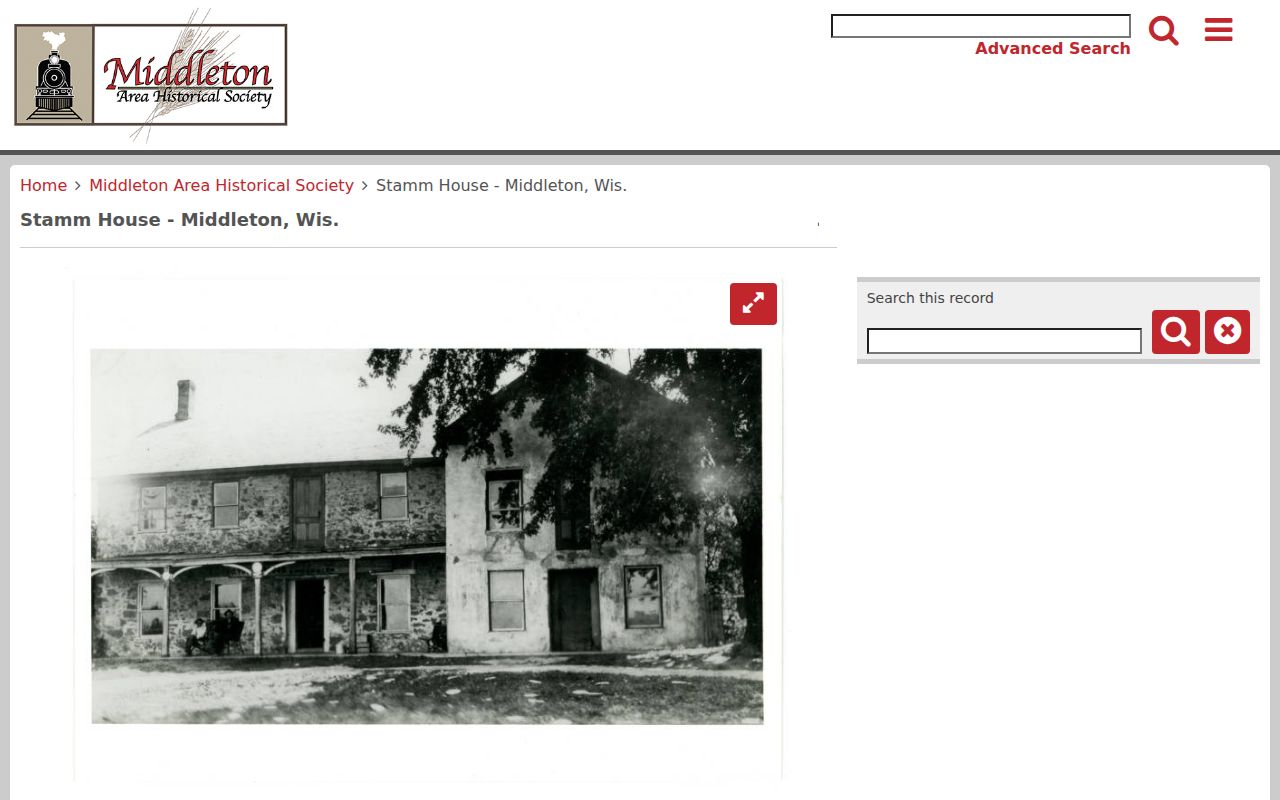
Item-level metadata carries the lesson. It preserves title, date, description, place, format, rights, and file history, yet it names no owner or occupant. Test the address against directory editions, maps, deeds, parcel data, and permits. Each source answers a different question.
Trace Families in Middleton Directories
Reliable family history in Middleton directories depends on tying every name to its edition. The page matters too. Work backward from the date you know. Then push forward through later volumes, watching for initials and spelling drift. When a name disappears, check street order, the years on either side, newspapers, and probate. Then review vital records before settling on an explanation.
- Choose a name, address, and date range, then select a volume whose scope can include Middleton.
- Search the alphabetic section and save publisher, year, page, and exact spelling.
- Check nearby editions for moves, spouse notes, occupation changes, business ties, or a final appearance.
- Use a reverse section, when present, to follow the address.
- Pair directory years with released census schedules, deeds, newspapers, and eligible vital records.
Census records open on a 72-year cycle. That leaves long stretches with no household snapshot. A Middleton city directory helps fill those gaps, though it can miss children, renters, and women listed only under a husband's name, and it never covers people the publisher left out.
Middleton History Help on Hubbard
Rowley House Museum and Middleton Public Library sit near each other on Hubbard Avenue. The museum at 7410 Hubbard holds artifacts, photos, postcards, and deep community knowledge. Its usual season runs mid-April through mid-October. Hours are Tuesdays 1-4 and Saturdays 10-1. Hours shift, so confirm before visiting. For current information, the Middleton Area Historical Society history page is the online lead. It covers the museum, the society's local-history mission, and visit details.
That page names the society behind Rowley House. That makes it a good contact for artifact context and collection questions, not a stand-in for a dated city directory entry. The library at 7425 Hubbard provides reference help. Museum staff can explain a building or event a directory mentions; librarians can help track down the source itself. Neither holds a complete resident roll. When you ask, bring the printed spelling, the estimated year, the street, and the directory citation you already checked. A narrow question lets staff zero in on a newspaper reel, local file, catalog record, or photograph. The Wisconsin Historical Society holds Sanborn originals for hundreds of communities, Middleton among them. Exact local years vary. Sanborn sheets show a building's footprint, construction, use, stories, outbuildings, and fire risk, but not current ownership. Maps and atlases give the name search geographic control. A historic map reveals whether a modern parcel was once farmland, wetland, a village lot, or part of another district. Middleton's "Peatsville" nickname points to peat harvesting, but that broad history proves nothing about a specific lot. Parcel-level evidence still does that work.
Middleton Directory Gaps Matter
A failed lookup has many innocent causes. The volume may exclude Middleton or skip a year. The entry may use initials, a formal business name, or an old street form. The scan itself may be hard to read. So cite the edition, section, spelling, and pages checked. Do not declare that no record exists. Middleton has no official obituary index, no complete newspaper span, and no city cemetery database. Ask library staff about microfilm and Wisconsin Historical Society newspapers. Then weigh the obituary against vital, probate, deed, or directory evidence. A death notice is a dated report. Its named relationships still deserve support from probate or an eligible vital record. Oral history carries similar limits. The library's earlier StoryCorps material documents plans for community interviews and a local-history room. It does not prove those collections are open today. Ask the reference desk about current access and consent conditions. Quote a narrator as a narrator. Never treat a narrator as the recorder of a deed or the keeper of a public roll. "Not listed in this edition" is sound once you have checked the scope. It is also sound once you have checked the pages. "Did not live in Middleton" is not. For current address evidence, use the Middleton street directory workflow.